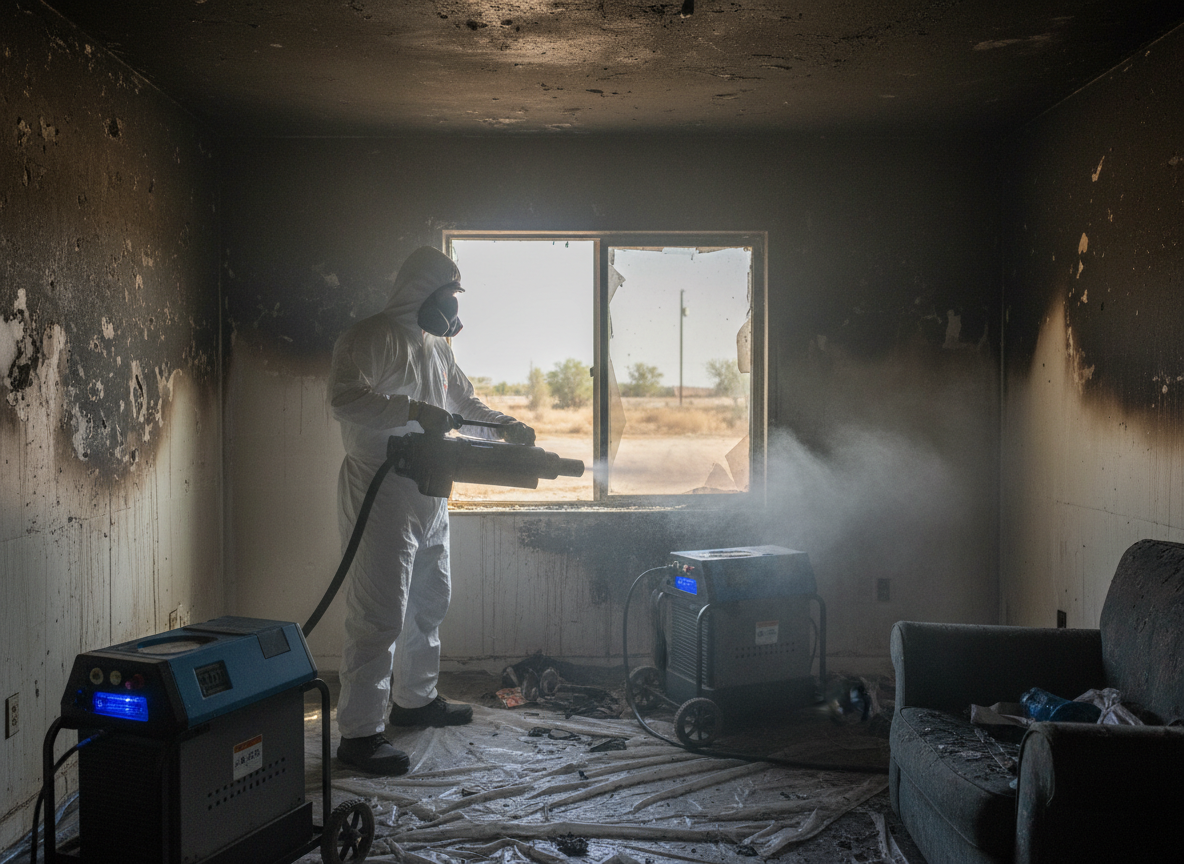
Laredo’s hot semi-arid climate accelerates the bonding of smoke residues into porous materials such as plaster, stucco and older wood framing common in Downtown and San Agustin Plaza homes. Once winter temperatures drop and heating systems run, trapped odors release again through HVAC ducts that were never designed for modern filtration. Standard cleaning fails because the low humidity keeps residues dry and powdery, allowing them to re-suspend every time the thermostat cycles.
Homes in Del Mar and Los Presidentes often have flat roofs and minimal attic ventilation, so smoke travels laterally into wall cavities during summer heat. We use penetrating neutralizers matched to the specific fuel load rather than blanket ozone treatments that can damage the thin plaster found in Webb County’s pre-1970 stock. Edge cases include residue inside aluminum window frames and under ceramic tile, both frequent in McAllen-adjacent construction styles.
After containment, we run negative-air machines with charcoal filtration for 48 to 72 hours while monitoring humidity to prevent secondary mold in the region’s occasional high-dew-point events. Final verification includes thermal imaging of ductwork and surface pH testing because alkaline soot from synthetic furnishings reacts differently with Laredo’s hard water than acidic residues from natural materials.
Technician insight
In Laredo, the thing that catches most people out with Odor Removal After Fire is how the hot semi-arid climate bakes smoke into the plaster and stucco of Downtown and Hillside homes so quickly that standard cleaners just push it deeper into the substrate.
Lingering Odor After Kitchen Fire
A kitchen fire in a Del Mar home left odors in the living areas and attic. Inspection showed residue had traveled through the shared ductwork because the system ran continuously during the hot summer. We performed source removal, applied penetrating neutralizers to wall cavities, and ran filtered negative air for three days. The homeowner reported no return of smell after the AC cycled through a full week of mild winter temperatures.
How it works
- 1
Initial Assessment
Inspect all rooms, attic spaces and HVAC runs to map smoke migration paths in the specific construction style of the neighborhood.
- 2
Source Removal
Remove or seal charred materials and vacuum loose soot using HEPA equipment before any odor counteractant is introduced.
- 3
Penetrating Treatment
Apply matched neutralizers to porous surfaces and run through ductwork to reach residues lodged in wall cavities common in older Laredo homes.
- 4
Air Purification
Operate negative-air filtration and thermal fogging as needed while maintaining humidity control suited to the semi-arid climate.
- 5
Verification
Conduct surface testing and occupant walkthrough to confirm no re-release occurs when systems cycle.
Pricing
Pricing depends on square footage, smoke migration depth and whether HVAC cleaning is required; we provide on-site assessments before any work begins.