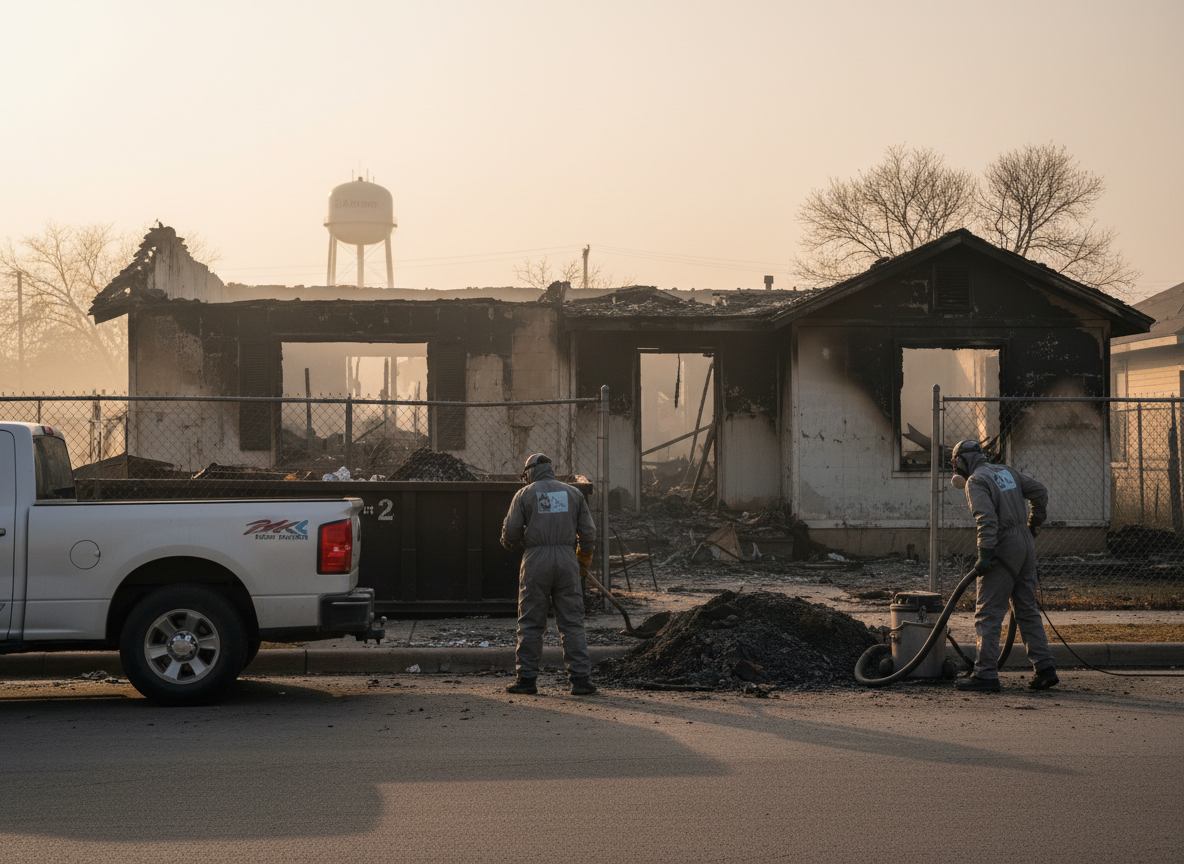
Hoarding cleanup after fire in Laredo demands careful sequencing because smoke and soot settle into stacked belongings and older construction common in Downtown and San Agustin Plaza neighborhoods. Webb County homes built before central air often have plaster walls and limited ventilation that trap particulates, requiring layer-by-layer removal rather than simple vacuuming. The region's hot semi-arid climate speeds surface drying yet leaves fine ash embedded in fabrics and insulation, raising the risk of re-soiling if crews skip HEPA filtration during final passes.
Technicians arriving from our McPherson Road location first isolate HVAC returns to prevent soot migration into unaffected rooms, a step that proves critical in Del Mar and Hillside properties where ductwork runs through attics exposed to summer heat. Edge cases include hidden embers inside piled newspapers or furniture that can reignite hours later if not fully extinguished and cooled. Disposal follows Webb County landfill rules for charred debris, and crews document every item category to support insurance claims without creating additional liability for the property owner.
After bulk removal, surfaces receive pH-neutral cleaners matched to the specific char type, followed by odor neutralization using equipment sized for the square footage. Homes near Los Presidentes or closer to Mission and McAllen sometimes show secondary water damage from suppression efforts that interacts with accumulated dust, creating mud-like residues that demand extra extraction passes. Final clearance testing confirms airborne particulate levels before any reconstruction begins.
Technician insight
In Laredo, the thing that catches most people out with Hoarding Cleanup After Fire is how the hot semi-arid summers bake soot deep into drywall and carpet padding in older Downtown and Hillside homes, so crews must remove more substrate than they would after a similar job in McAllen where humidity keeps residues nearer the surface.
Del Mar home with attic storage fire
A fire started in boxed papers stored in the attic of a Del Mar residence and spread soot through open ceiling joists. We found hidden embers still warm inside stacked clothing and discovered water from suppression had pooled under floorboards. After isolating the HVAC and removing layers in controlled passes, we extracted the remaining residue and confirmed clearance so the family could begin repairs.
How it works
- 1
Initial Safety Assessment
Crew evaluates structural integrity, identifies hidden fire pockets, and maps hoarded zones while wearing full PPE before any material handling begins.
- 2
Containment and HVAC Isolation
Plastic barriers and negative air machines seal work areas; returns are taped off to stop soot travel through the home's duct system.
- 3
Layered Removal and Sorting
Items are removed in passes, categorized for salvage or disposal, with documentation for insurance while preventing cross-contamination.
- 4
Deep Cleaning and Odor Treatment
HEPA vacuuming, surface washing, and thermal fogging address embedded residues before final clearance testing.
Pricing
Cost depends on volume of hoarded material, fire damage depth, and whether secondary water or mold issues exist; an on-site assessment provides the accurate range.