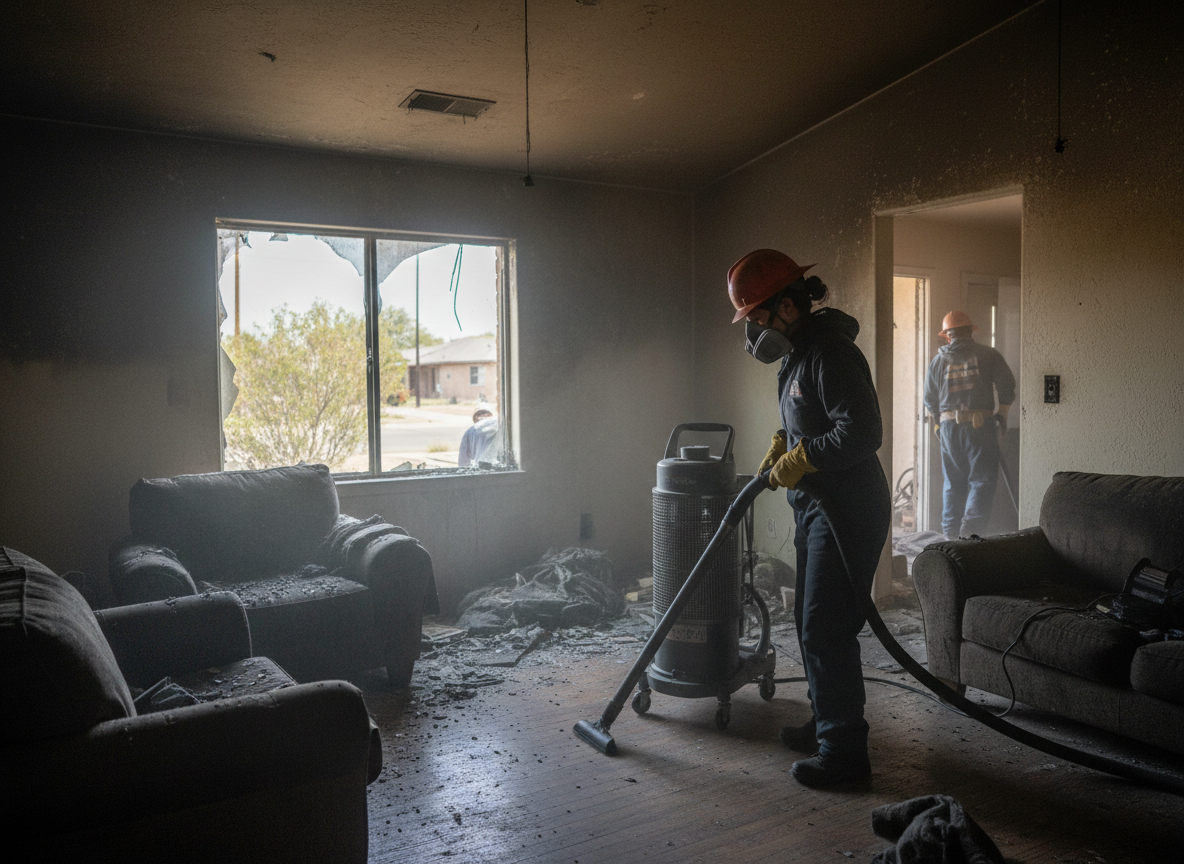
Laredo’s hot semi-arid climate means summer fires often involve rapid flame spread through dry vegetation and older wood-frame homes common in Downtown and around San Agustin Plaza. Soot travels farther on prevailing winds, embedding in porous materials like plaster and lathe that predate modern fire codes in many Hillside properties. Restoration crews must account for this by isolating HVAC systems early, because dust and low humidity allow fine particles to remain airborne longer than in humid regions.
Webb County homes near the Rio Grande often sit on clay-heavy soils that retain moisture after firefighters use large volumes of water. This creates hidden pockets of saturation beneath slab foundations and in crawl spaces typical of Del Mar construction. Technicians check for these conditions with moisture meters before drywall removal to avoid leaving damp cavities that later support mold during the region’s mild winters.
Smoke odor in Los Presidentes tract homes frequently migrates through shared attic spaces and returns via HVAC ducts that serve multiple units. Standard ozone treatments alone rarely reach these paths, so crews combine thermal fogging with targeted duct cleaning to prevent recurring smells after residents return. Older electrical systems in these neighborhoods also require inspection for hidden arc damage before power is restored.
Technician insight
In Laredo, the thing that catches most people out with Fire Damage Restoration Near Me is how wind across the flat terrain pushes soot into attics of neighboring houses in Del Mar and Los Presidentes even when the original fire stayed contained. Homeowners often skip checking shared attic spaces and HVAC returns, which lets the smell return weeks later once the weather turns hot again.
Kitchen Fire Smoke in Hillside Residence
A cooking fire in a 1970s Hillside single-story home sent smoke through the central air handler. Inspection showed soot lodged in flex ducts and settled on clay soil beneath the slab. Crews isolated the system, performed duct cleaning, applied moisture control under the slab, and completed odor removal. The family returned without recurring smell once summer heat arrived.
How it works
- 1
Emergency Board-Up and Site Security
Secure openings and tarp roofs to prevent weather intrusion while assessment continues.
- 2
Soot and Smoke Mapping
Document affected surfaces and HVAC paths using visual inspection and air sampling.
- 3
Contents Removal and Cleaning
Pack out salvageable items for off-site cleaning and catalog unsalvageable materials.
- 4
Structural Restoration and Odor Removal
Remove damaged materials, clean remaining surfaces, and apply odor neutralization.
- 5
Final Clearance and Rebuild Coordination
Verify air quality and moisture levels before returning the property to the owner.
Pricing
Upfront written estimates provided after on-site inspection; cost depends on square footage affected, smoke migration into HVAC, and hidden moisture in slab homes.